
Nico
Delila en de anderen
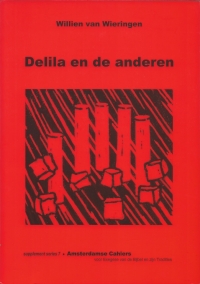
Een syntactisch georiënteerd bijbels-theologisch onderzoek naar de rol van de vrouwen in de Simson-cyclus (Richteren 13-16), dissertatie door Willien van Wieringen
Delila en de anderen. Wie gevraagd wordt naar de vrouwen in het levensverhaal van Simson, komt al snel op de naam van de vrouw die hem fataal geworden is. Maar wie die anderen zijn, blijkt lastiger te beantwoorden, terwijl toch ook zijn moeder, zijn bruid, de zus van de bruid en een hoer een rol spelen in het leven van Simson. Dit boek is de neerslag van een onderzoek naar de manier waarop waarop het levensverhaal van Simson (Richteren 13-18) is opgeschreven. Zorgvuldig kijken naar de taalstructuur en vertelstrategie is daarbij de weg om te achterhalen wat de verteller de lezer wil meedelen: wat is de theologische agenda van de verteller, en hoe heeft hij de vrouwelijke personages ingezet om die agenda bij de lezer te brengen? Naast de vijf vrouwen in het leven van Simson worden ook de andere vrouwen in het Richterenboek betrokken bij het onderzoek en lijnen getrokken van Aksa tot en met de meisjes van Silo.
The Reader-Oriented Unity of the Book Isaiah
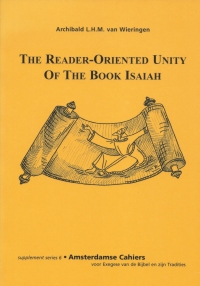
door Archibald L.H.M. van Wieringen
This monograph contains a reader-oriented analysis of the book lsaiah as a whole. This research shows that the implied reader is manipulated by a reader-oriented book structure in which a single spatial décor, a single arrangement of time, the prophetic role of lsaiah as both character and discursor/narrator and the roles ‘king’ and ‘enemy’ in various manifestations occur.The research is completed by an examination of the reader-oriented consequences for the diachrony of the book lsaiah, which results in a fresh theory about the development of the book lsaiah.
Experimenting with Koheleth
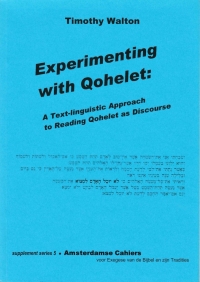
A Text-Linguistic Approach to Reading Qohelet as Discourse, dissertation by Timothy Walton
Is it possible to analyze a text from Biblical Wisdom or Poetry as a discourse? Can this be accomplished by a systematic analysis of the linguistic features observed in such a text? Can we identify the linguistic features that are most effective in signaling to the reader the text’s syntactic relationships and cohesive ties which are often difficult to determine in non-narrative texts? If such an experiment proves successful, can this type of discourse analysis help us in answering the text’s most important interpretive questions? Experimenting with Qohelet: A Text-linguistic Approach to Reading Qohelet as Discourse seeks to answer these questions by applying a thorough text-syntactic analysis to the book of Qohelet. The approach described in this book simulates the reading process by first identifying the text’s various linguistic features and then determining the syntactic relationships and the discourse functions of the text segments, utilizing the computer programs developed by prof. dr. Eep Talstra and his colleagues in the Werkgroep Informatica of the Vrije Universiteit in Amsterdam. It was concluded that this type of text-linguistic analysis is not only necessary for proper exegesis but should be the initial step for all exegetical approaches to non-narrative biblical Hebrew texts.
Om voor te lezen – Miqra
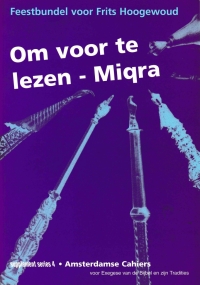
Feestbundel voor Frits Hoogewoud
(ed. H. Blok, K.A. Deurloo, P.J. van Midden, F. Postma, K. Spronk)
‘Het is onmogelijk de hebreeuwse bijbel, het Oude Testament, goed te vertalen. Toch moet het gebeuren …. De poging moet herhaald worden, van revisie tot vernieuwing zal er werk aan de winkel zijn en dat zal duren totdat de messias komt en de vertaling overbodig is omdat ieder de taal van het paradijs spreekt en verstaat.’ Dit woord van zijn leermeester M.A. Beek heeft Frits Hoogewoud heel zijn actieve leven begeleid. Hij was de drijvende kracht achter de serie vertalingen van de Societas Hebraica Amstelodamensis. Hij gaf deze de ondertitel mee: ‘Een vertaling om voor te lezen’. Leden van de vertaalgroepen der SHA, societasgenoten en collega’s van de Bibliotheca Rosenthaliana schreven opstellen voor deze bundel over vertaalmethodiek, over exegese en vertaling en over concrete tekstproblemen. Ze leveren daarmee een bijdrage aan de discussie die met het verschijnen van de Nieuwe Bijbelvertaling opnieuw actueel is geworden. ‘Het gaat er niet om of de bijbelvertaler mooi vertaalt, maar wel dat hij juist en zonder vooroordeel doorgeeft wat hij gehoord heeft.
The New Things
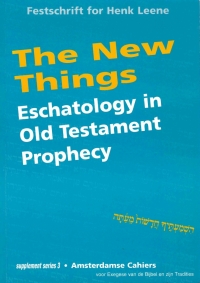
Eschatology in Old Testament Prophecy: Festschrift for Henk Leene
(ed. by Ferenc Postma, Klaas Spronk and Eep Talstra)
A Festschrift in honour of Henk Leene at his taking leave as professor of Old Testament at the Vrije Universiteit Amsterdam, containing studies on Old Testament prophecy and eschatology with special emphasis on the Second Isaiah, by W.A.M. Beuken, H.-J. Hermisson, K. Schmid, E. Talstra and many others from the colleagues of the Biblical Department of the Vrije Universiteit, of the Oudtestamentisch Werkgezelschap in Nederland en België, of the Jesaja-werkplaats and of the Societas Hebraica Amstelodamensis.
Unless someone guide me…
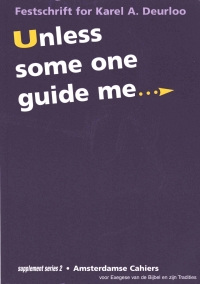
Festschrift for Karel A. Deurloo
(ed. J.W. Dyk, P.J. van Midden, K. Spronk, G.J. Venema, R. Zuurmond)
A Liber Amicorum for Karel A. Deurloo, professor of Old Testament at the University of Amsterdam and guide to the biblical text for numerous students and scholars. Colleagues and friends offer him this book at the occasion of his official farewell to the University of Amsterdam. A compilation of articles in English, German and French is here presented: Biblical Theology, Exegesis and Liturgy, three areas in which Karel Deurloo has distinguished himself. This edition is an initiative of the Societas Hebraica Amstelodamensis. Karel Deurloo is one of the members of the Editorial Board of Amsterdamse Cahiers voor Exegese van de Bijbel en zijn Tradities (ACEBT).
The Rediscovery of the Hebrew Bible
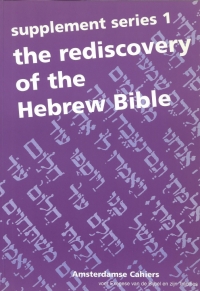
(ed. J.W. Dyk, P.J. van Midden, K. Spronk, G.J. Venema)
To read the Bible as something unfamiliar, to let it speak anew, overwhelming us with its images and language, confronting us with its message, inviting us to respond – this is the challenge which occupies each of the authors of this volume. Various techniques for getting closer to the text of the Hebrew Bible are presented, and the results illustrate the fruitfulness of such an approach.
ACEBT Supplement Series 1 contains contributions by K.A. Deurloo, G.J. Venema, A. Blokker, P.J. van Midden, J. Dubbink, J.C. Siebert-Hommes, E. Talstra, K.A.D. Smelik and R. Zuurmond.